On this page +
Two panel brands installed by the hundreds of thousands in 1950s–1980s homes — Federal Pacific Electric (FPE / Stab-Lok) and Zinsco — have a documented history of breakers that fail to trip during a fault. That's the dangerous part: not nuisance tripping, but silence when tripping is the one thing the panel exists to do. Austin's mid-century neighborhoods are full of both. Checking which brand you have takes thirty seconds at the panel door, and this guide shows you exactly what to look for, what the risk actually is, and what replacement involves — including the real numbers.
The danger is the silence, not the tripping
Every breaker panel has exactly one safety job: when a circuit faults, trip — cut the power before the wiring overheats. We’ve written about what tripping means, and the short version is that a breaker doing its job loudly is a breaker you can trust.
Two panel brands, installed in enormous numbers across American homes from the 1950s into the early 1980s, have a documented history of failing at that one job: Federal Pacific Electric (FPE), with its Stab-Lok breaker design, and Zinsco, later sold as GTE-Sylvania. Independent testing of Stab-Lok breakers found meaningful rates of failure to trip under fault conditions. Zinsco’s design has its own documented failure mode: breaker internals can seize or burn while the handle still flips back and forth like everything’s fine.
Read that again, because it’s the opposite of the problem homeowners expect. The risk isn’t nuisance tripping. It’s a breaker that stays silent during the fault — that lets a shorted circuit keep pulling current, heating the wire behind your drywall, while the panel looks perfectly calm. A panel like that isn’t protection. It’s a metal box holding switches.
A breaker that fails to trip is worse than one that trips too much. One is an annoyance. The other removes the single protection your wiring has — and you can't see the difference from the outside.
Why this is an Austin story
Austin’s most-loved neighborhoods are exactly the ones at risk. The housing stock in Allandale, Crestview, Brentwood, Hyde Park, Windsor Park, University Hills, Barton Hills, and the older streets of South Austin went up in the very decades these panels were the builder’s default. A 1964 ranch that’s never had its electrical service touched has a panel that’s now sixty-plus years old — and a real chance it’s one of these two brands.
The houses have been remodeled — kitchens opened up, offices added, minisplits and EV chargers installed. The panels, very often, have not. We open these doors every week, and finding original FPE or Zinsco equipment behind them is not a rare event. It’s a Tuesday.
There’s a second, newer force pushing this issue: insurance. Texas carriers have grown steadily less willing to cover homes with these panels. It surfaces at renewal, at policy shopping, and hardest of all during home sales — an inspector flags the panel in the option period, and suddenly the replacement is happening on a deadline with a negotiation attached. The homeowners who replace on their own schedule get to choose their timing and their electrician. The ones who wait get theirs chosen for them.
The 30-second check
Open the panel door — just the door, never the metal cover behind it — and look for two things.
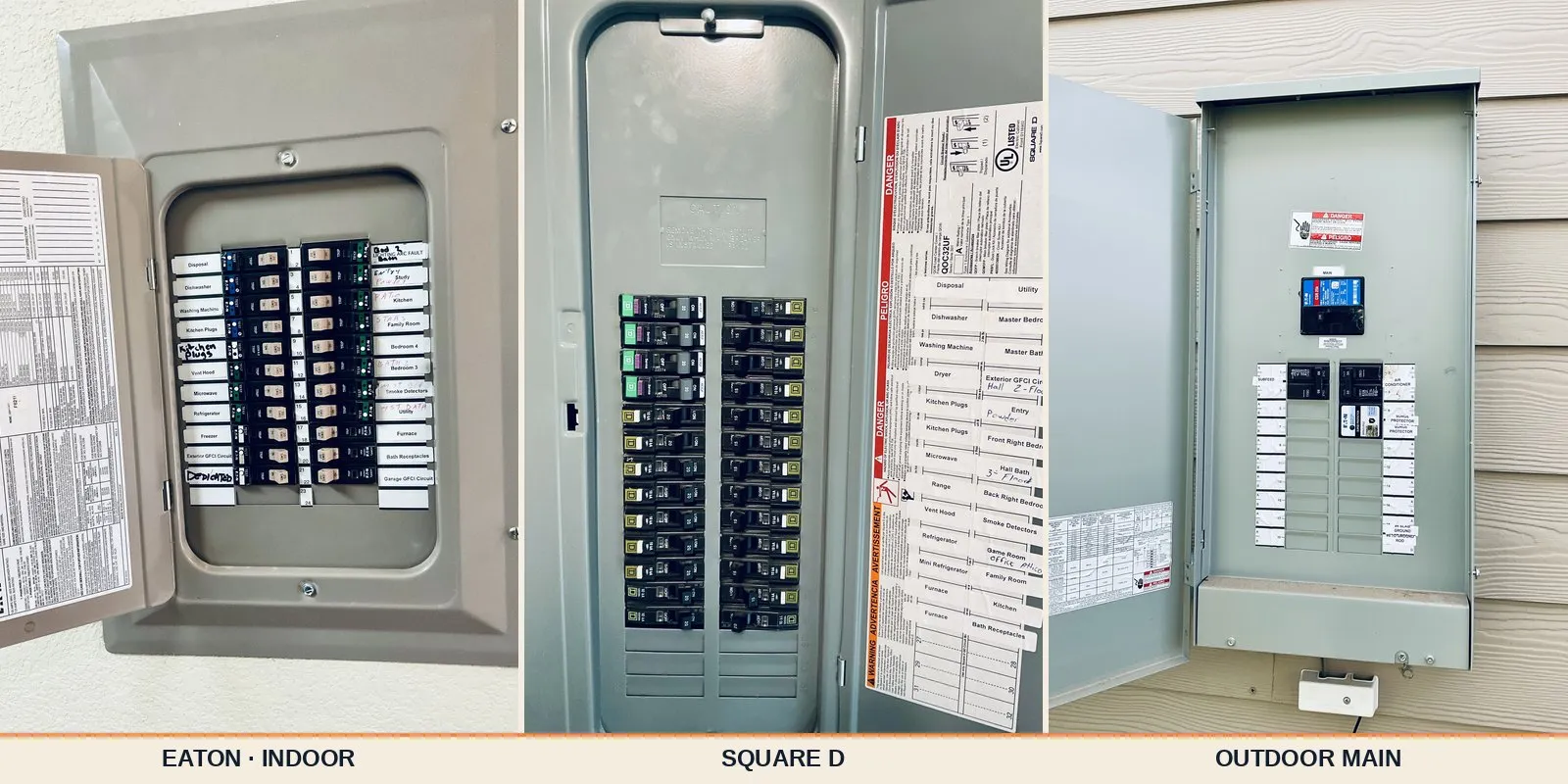
The label. Inside or on the door: Federal Pacific Electric, FPE, or Stab-Lok in any combination is a match for the first family. Zinsco, GTE-Sylvania, or Sylvania-Zinsco is the second. (Not every Sylvania panel is a Zinsco design — that’s part of what a confirming look sorts out.)
The breakers. Stab-Lok breaker handles commonly carry a red stripe. Zinsco handles come in colors — teal, red, blue — lined up like a crayon box, a look no modern panel has.
If the label’s painted over or gone and your home dates to 1950–1985 with its original panel, treat it as unconfirmed rather than fine. A photo of the open panel door is enough for us to identify most of them on sight — send it over before you spend a dime on anything.
And if your panel turns out to be a modern brand: good. Then the question becomes whether it has the capacity your home needs, which is a different conversation — start with our overload guide and the numbers on your breaker handles.
”It’s been fine for fifty years” — the trap in the logic
This is the objection we hear most, and it deserves a real answer rather than a scare line.
A panel’s safety job is invisible in normal life. It does nothing — correctly — for years at a time. The job only exists in the worst sixty seconds the house ever has: a short behind a wall, a failed appliance, a nail through a cable. That is the moment a Stab-Lok or Zinsco breaker is documented to fail, and it’s the only moment that was ever the point.
So “it’s been fine” usually means “it’s never been tested.” The panel hasn’t proven it works; it’s proven the house hasn’t had a fault yet. Quiet decades are exactly how this risk hides — and why these panels still sit in so many Austin homes whose owners reasonably assumed silence meant safety.
We don’t say that to alarm you. Plenty of these panels get replaced calmly, on a planned Saturday, with no drama at all. That’s the version we’re recommending — the planned one.
What replacement actually involves
A panel replacement is a routine, one-day job for us — and a permitted, inspected one, always. Here’s the real shape of it:
- It starts with a load calculation, not a price sheet. What service does the house have, what does it run today, what’s coming (EV? heat pump? ADU?). That math decides whether you need a like-for-like panel replacement or a full service upgrade — bigger wire, new meter equipment, more capacity for the next thirty years.
- The numbers: panel work runs from about $3,000 for a panel replacement to $10,000 for a full service upgrade. Where your job lands depends on that load calculation and the condition of what’s feeding the panel — and you’ll have the flat-rate price in hand before work begins, because the price always comes before the work. Financing starts at $175/month if that makes the timing easier.
- The day of: power is off during working hours, every circuit lands on a new breaker in a clean, labeled panel, and if the service is being upsized we coordinate the utility side — you don’t make those calls.
- After: the city inspects, and our 10-year workmanship warranty covers the panel work. Top-tier equipment, manufacturer’s lifetime parts warranty, and breakers that will trip when your house finally asks them to.
The full picture — what’s in scope, what the process looks like, what to expect week by week — lives on our panel upgrade page.
If the label behind your panel door says FPE, Stab-Lok, or Zinsco — or you’d just rather know than wonder — call us at (512) 954-4782 or book online. Send a photo of the panel if you want a head start; we identify most of them on sight. We serve homes across Greater Austin, you’ll see exactly what we find, and the decision stays where it belongs: with you.
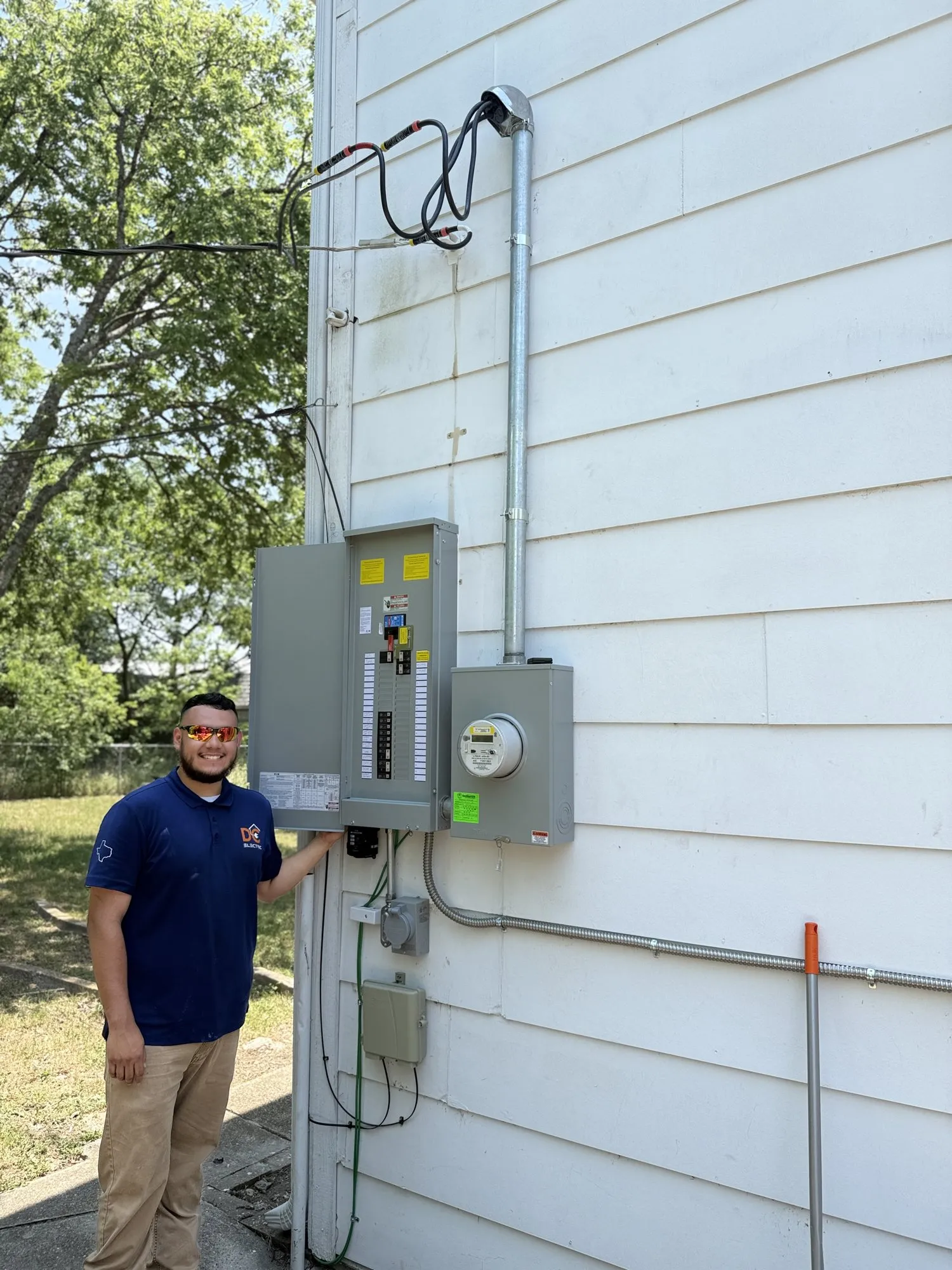
If you're in doubt, call DC Electric out.
Whatever the electrical question, a Lead Technician comes out, does a thorough check, and gives you a clear course of action with a guaranteed repair or fix — and an upfront flat-rate price before any work begins.
How to check your panel brand in 30 seconds
- Open the panel door — just the door. The label you need is printed on or inside it.
- Read the label. Federal Pacific Electric, FPE, or Stab-Lok in any combination is a match. So is Zinsco, GTE-Sylvania, or Sylvania-Zinsco.
- Look at the breaker handles. Stab-Lok breakers often carry a red stripe. Zinsco handles come in colors — teal, red, blue — lined up like crayons.
- No label and no colors? Homes built 1950–1985 that still have their original panel are worth confirming either way. Snap a photo and send it to us.
- Your panel says FPE, Stab-Lok, Federal Pacific, Zinsco, or Sylvania-Zinsco — and anything in the house buzzes, flickers, or smells hot
- A breaker in one of these panels feels hot to the touch
- A breaker never trips — even during faults that should have tripped it
- Scorch marks, melted spots, or discoloration anywhere on the panel
- Your insurer has flagged the panel at renewal — coverage timelines move faster than you'd think
We believe your home should have safe, reliable electrical wiring to protect your family's well-being.
Common questions
How do I know if I have a Federal Pacific or Zinsco panel?
Are FPE and Zinsco panels actually dangerous, or is it hype?
My FPE panel has worked fine for 50 years. Why replace it now?
Will insurance cover a home with an FPE or Zinsco panel?
What does it cost to replace an FPE or Zinsco panel in Austin?
How long does a panel replacement take?
Standing By to Take Your Call
Book online any time, or give us a call and we'll get you scheduled — existing customers reach us 24/7.