On this page +
A circuit is overloaded when the things plugged into it ask for more current than its wiring can safely carry. The signs show up before the breaker trips: lights that dim when an appliance kicks on, a warm outlet or switch plate, a faint buzz, an extension strip doing a job a wall outlet should. The fastest way to confirm it is the one most homeowners never try — open your breaker box and read it. The numbers on each breaker handle tell you exactly what each circuit can carry, and fifteen minutes with a notepad tells you which circuits are doing too much. This guide walks you through both: the warning signs, and how to read your panel like we do.
The breaker is the last warning, not the first
Most homeowners find out a circuit is overloaded when the breaker trips. But the breaker is the end of the story — the hard stop that fires when the limit is already crossed. An overloaded circuit almost always announces itself earlier, more quietly, and those early signals are worth knowing because they show up while the problem is still cheap.
Here’s what an overloaded circuit sounds and looks like before the clunk:
- Lights dim or flicker when something kicks on. The fridge compressor starts, the microwave runs, the AC cycles — and the lights on that circuit sag for a half-second. That’s voltage dropping because the circuit is near its ceiling. (If lights flicker all over the house, that’s a different and more serious animal — see when one room loses power for how to tell.)
- A warm outlet, switch plate, or plug. Current generates heat. A faceplate that’s warm to the touch is a circuit working harder than it should — or a connection coming loose behind it. Either way, that’s a repair visit, not a wait-and-see.
- Buzzing or sizzling. Electricity done right is silent. A buzz from an outlet or the panel is current fighting through a connection.
- The power-strip lifestyle. If a room runs on a daisy chain of strips and extension cords, the outlets aren’t the shortage — the circuits behind them are. The strips are the symptom of a house asking one circuit to do three circuits’ work.
- One appliance can never run while another is on. Every household has learned a rule like “not the space heater and the hair dryer at the same time.” That rule is the overload — you’ve just been working around it by hand.
Tripping is the last symptom, not the first. Dimming, warmth, buzzing, and power-strip workarounds all arrive earlier — and they're the cheap stage of the problem.
Read your panel like an electrician does
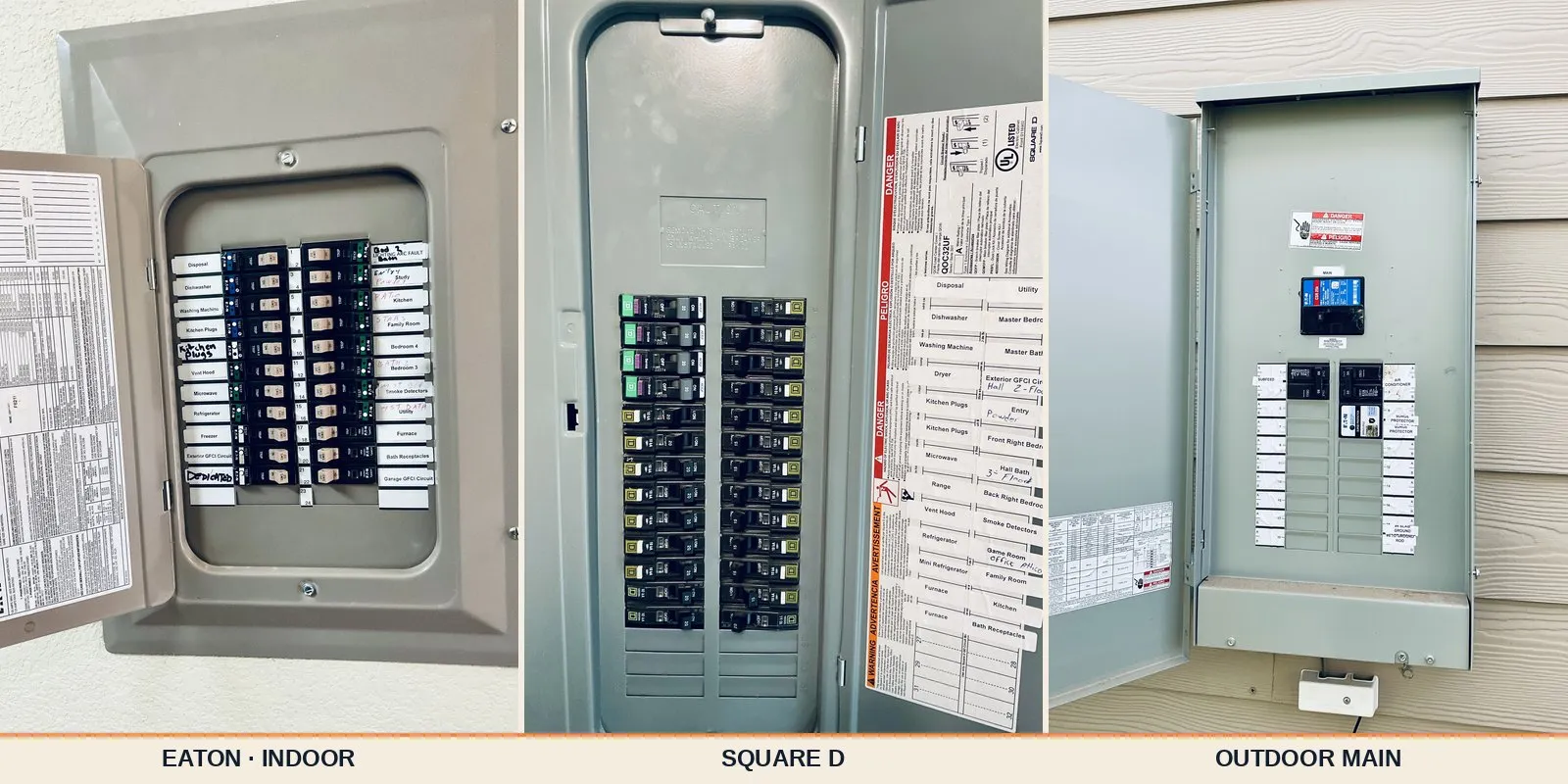
You don’t need tools for this, and you never take the metal cover off — everything you need is on the breaker handles and the door directory. Open the panel door and you’re looking at your home’s entire electrical budget, written in numbers.
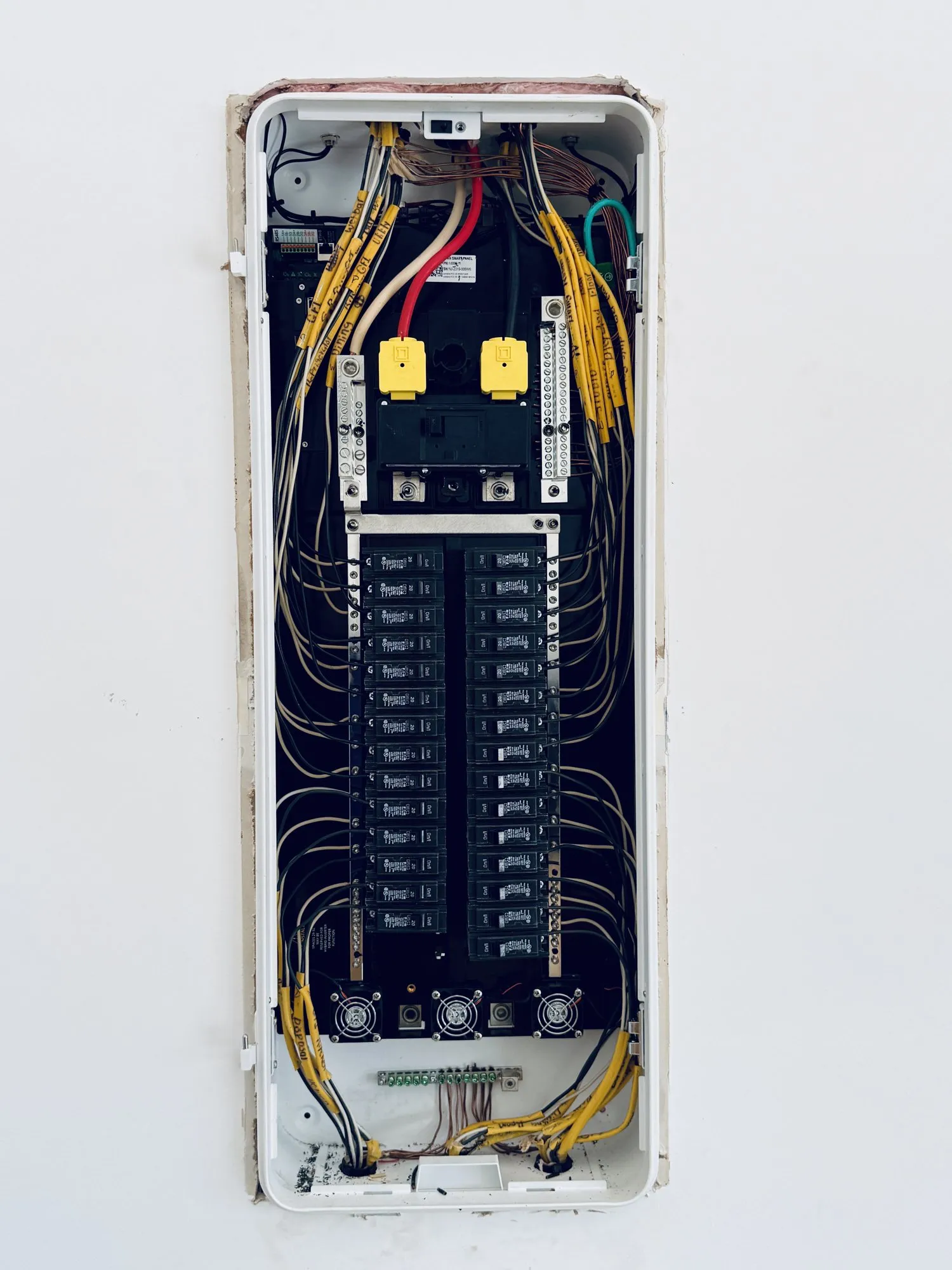
The main breaker is the big paired handle, usually at the top. Its number is the whole house: 100, 150, 200 amps. Everything below it shares that total.
The single (one-handle) breakers — the 15s and 20s — run your lights and outlets. The number on the handle is the most current that circuit is allowed to carry, and it’s matched to the thickness of the wire in the wall behind it. A 15 protects 14-gauge wire; a 20 protects 12-gauge. That matching is why “just put in a bigger breaker” is the one move you should never make: the breaker isn’t limiting your appliances, it’s protecting your wiring.
The paired (two-handle) breakers — 30s, 40s, 50s — each run a single big appliance at 240 volts: the dryer, the range, the AC condenser, a water heater, an EV charger. Count them and you’ve listed every major load in your home.
The directory — the card or labels on the door — tells you which breaker owns which room. In the Austin homes we open, maybe one directory in five is complete and correct. If yours is blank, an afternoon of flip-and-check is one of the most useful things you can do for your house: turn one breaker off, walk the house, note what died, label it, repeat. The day something goes wrong, that card is gold.
Now the budget math. Breakers are built to carry 80% of their rating continuously — about 12 amps all day on a 15, about 16 on a 20. The last 20% is headroom for surges, like a compressor starting. So when the toaster (8 amps) and the microwave (13 amps) share one 20-amp kitchen circuit, the math fails before the breaker ever moves — 21 amps of demand on a circuit designed for 16 continuous. That circuit will trip on busy mornings forever, because the problem is arithmetic, not equipment.
The microwave question, answered properly
“Why does my microwave keep tripping the breaker?” is one of the most-asked electrical questions in Austin, and the answer above is most of it: a countertop microwave pulls 12–15 amps by itself, which is nearly an entire 20-amp circuit. Modern code hands the microwave its own dedicated circuit for exactly that reason.
But many central Austin kitchens — the 1960s and 70s stock in Allandale, Brentwood, University Hills, the older streets of South Austin — predate that rule by decades. The microwave shares with the coffee maker, the air fryer, sometimes half the counter. Two of them run together and clunk.
The fix is not a bigger breaker (see above — never). It’s a dedicated circuit: one new run of wire from the panel to the kitchen, one new breaker. It’s a routine half-day job, it ends the morning roulette permanently, and it’s the single most common overload fix we do. If the panel has space, it’s simple. If the panel doesn’t have space — no open slots, or no capacity left — the overload conversation becomes a panel conversation, which brings us to the bigger picture.
When the overload isn’t one circuit — it’s the whole panel
Sometimes the flip-and-check afternoon tells you something bigger than “the kitchen circuit is crowded.” It tells you the house is crowded. The signs:
- The main breaker is 100 amps or less, and your home runs central AC plus an electric dryer plus a modern kitchen.
- Every slot in the panel is full — some maybe doubled up with slim “tandem” breakers, the panel equivalent of a power strip.
- Multiple rooms share single circuits, so spreading the load just moves the trip from one room to another.
A meaningful share of central Austin homes still run on 100-amp service or less, sized for how families used electricity in 1965 — no AC in every room, no EV in the garage, no home office, no induction range. A modern household generally wants 200-amp service, and the gap between those two numbers is why some homes can’t solve overloads by rearranging appliances. There’s simply no budget left to rearrange.
That’s a panel upgrade conversation. It starts with a load calculation — the formal version of the notepad math you did above, done to code, accounting for every fixed appliance and square foot — and it ends with a number: what your house has, what your house needs. Panel work runs from about $3,000 for a panel replacement to $10,000 for a full service upgrade, financing starts at $175/month, and our panel workmanship carries a 10-year warranty. You’ll know which end of that range you’re on before any work begins, because the price comes before the work — always.
One more thing the panel check can surface, and it matters more than capacity: what brand is on the label. If the inside of your panel door says Federal Pacific, Stab-Lok, or Zinsco, capacity is no longer the first question — read this before anything else.
What’s safe to do yourself — and what isn’t
Safe, and genuinely useful: everything in this article so far. Reading the breaker handles. Mapping and labeling circuits. Spreading loads — moving the space heater to a different room’s circuit, running the microwave and toaster in sequence instead of together. Noticing warmth, buzzing, and dimming, and writing down when they happen. That record alone can cut a diagnosis visit in half.
Not safe: anything past the panel door. Removing the metal cover exposes energized bus bars that remain live even with the main breaker off. Swapping breakers, “upsizing” a breaker, or adding a tandem to a full panel — those are inside-the-cover jobs, and the breaker-to-wire match they involve is exactly the thing that keeps an overload from becoming an overheated wall. If the fix involves the cover coming off, that’s where we come in.
If a circuit in your home keeps asking for more than it can give — or your panel math came up short — call us at (512) 954-4782 or book online. We serve homes across Greater Austin, and the visit starts with a diagnosis, not a sales pitch: what’s overloaded, why, and what it actually takes to fix. You see the findings and the flat-rate price, and you decide from there.
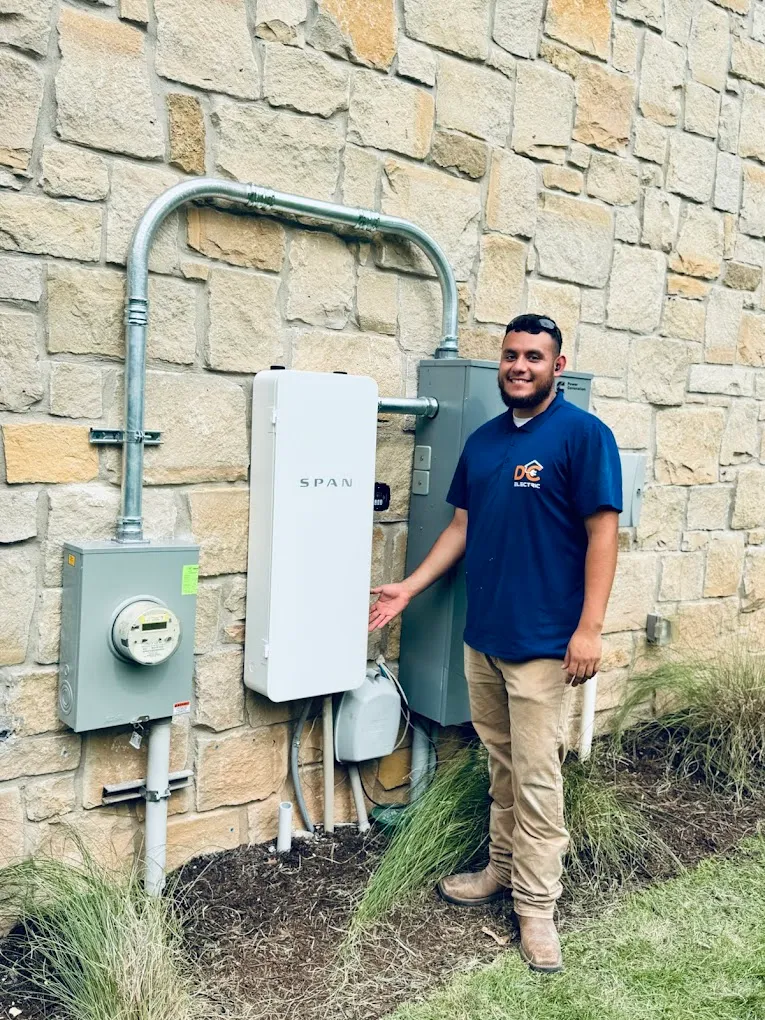
If you're in doubt, call DC Electric out.
Whatever the electrical question, a Lead Technician comes out, does a thorough check, and gives you a clear course of action with a guaranteed repair or fix — and an upfront flat-rate price before any work begins.
How to read your breaker box
- Open the panel door — just the door, never the metal cover behind it. Everything you need is on the handles and the directory.
- Find the main breaker. The big double handle at the top. Its number — 100, 150, 200 — is your whole home's capacity in amps.
- Read the single breakers. 15s and 20s run lights and outlets. The number is the most current that circuit can carry.
- Find the paired (double) breakers. 30s, 40s, 50s — these run one big appliance each: dryer, range, AC, water heater, EV charger.
- Match breakers to rooms using the directory. If it's blank or wrong, map it: flip one breaker off, note what went dark, label it.
- An outlet, switch plate, or cord that's warm to the touch
- A burning smell or buzzing from an outlet or the panel
- Lights that dim across the whole house, not just one room
- A breaker that trips repeatedly even after you've spread the load
- You counted your panel and the math doesn't cover what your home runs
We believe your home should have safe, reliable electrical wiring to protect your family's well-being.
Common questions
How do I know which circuit is overloaded?
Why does my microwave keep tripping the breaker?
What is the 80% rule for circuits?
Can I just replace the breaker with a bigger one?
How many amps does my home actually need?
Standing By to Take Your Call
Book online any time, or give us a call and we'll get you scheduled — existing customers reach us 24/7.