On this page +
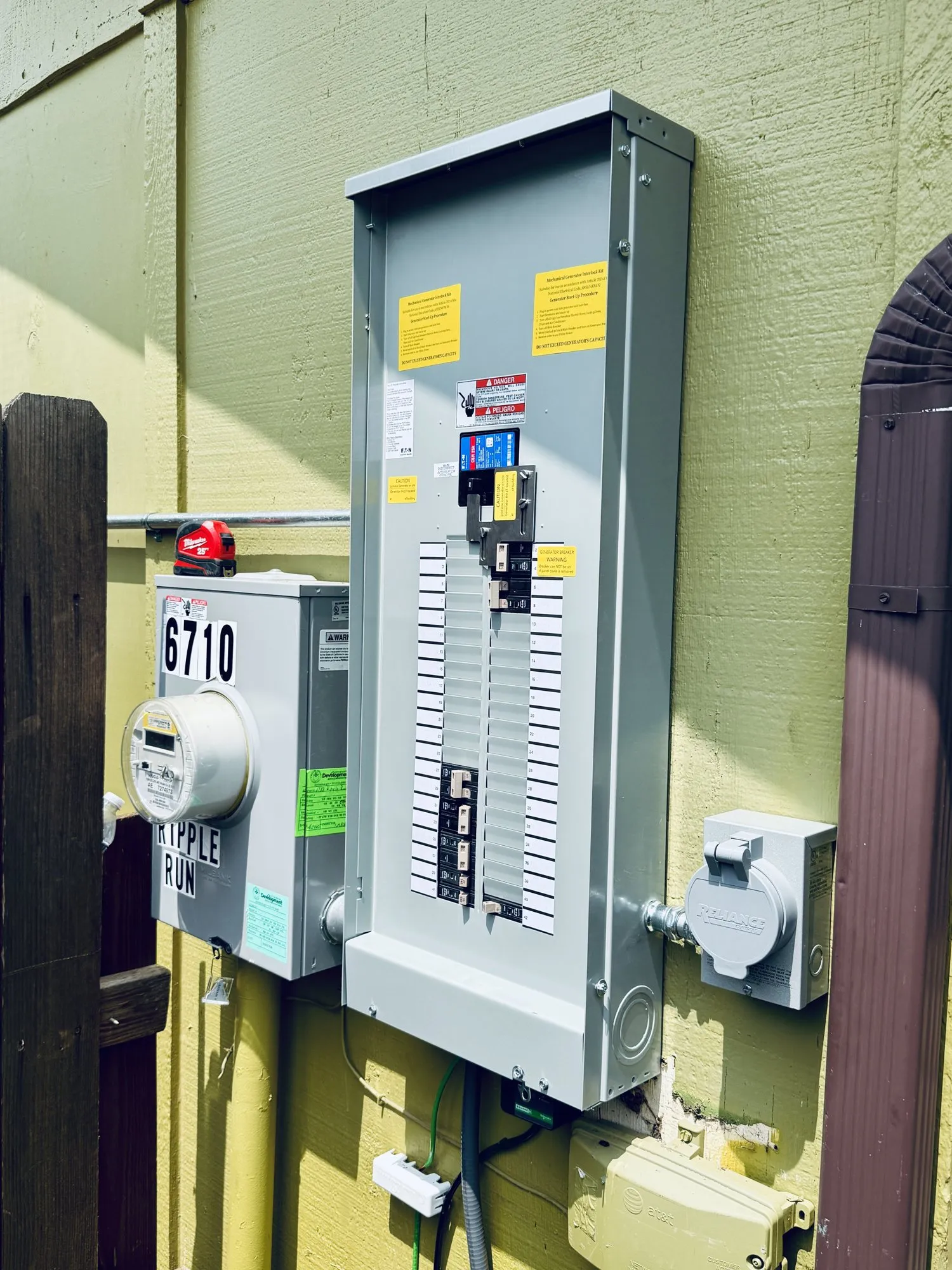
In Greater Austin, installing a UL-listed main-breaker generator interlock kit and weatherproof 30A or 50A exterior power inlet box typically costs $950–$1,950 (plus $1,000–$2,600 if you still need to buy a high-output portable or tri-fuel inverter generator). By comparison, a permanently plumbed whole-home standby generator (22kW–26kW Generac or Kohler with automatic transfer switch, concrete pad, gas plumbing, and permits) runs $12,000–$22,000+. Adding a $450–$850 HVAC compressor soft-start lets a 50A portable setup run central AC for roughly one-fifth the price of standby.
Need a licensed Austin electrician? Explore our Austin Panel Upgrades service, permits & upfront pricing →
Why so many Austin homeowners own a generator they still can’t safely plug in
Walk down almost any street in Lakeway, West Lake Hills, Cedar Park, or Round Rock after a February ice storm or a May straight-line wind microburst, and you’ll hear portable generators humming in driveways — with orange extension cords pinched through cracked front doors and sliding windows.
Extension cords keep a refrigerator cold, and that’s about it. They can’t power your hardwired gas furnace blower in a freeze, they can’t run your well pump, ceiling lights, garage door opener, or central AC, and leaving a window or door cracked lets freezing air, 100°F humidity, and deadly carbon monoxide drift straight back into the house.
At the other extreme, homeowners call a big-box standby generator salesperson, get handed an $18,000 quote with a six-week gas-plumbing and HOA review timeline, and do nothing at all.
There is a massive middle ground that most national articles gloss over: a code-compliant 50-amp generator interlock kit and exterior power inlet. Here is the honest, side-by-side 2026 cost and capability breakdown so you pick the right level of ERCOT backup for your family.
A 50A interlock + inlet delivers 80% of the real-world storm comfort of a standby system for roughly 20% of the cost. The trade-off isn't which rooms get power — it's five minutes of manual setup outside versus automatic 10-second switchover.
2026 Austin Backup Power Comparison Table
| Backup Option | Installed Electrical Cost | Total All-In Cost (With Unit) | Switchover | Can It Run Central AC? |
|---|---|---|---|---|
| 30A / 50A Interlock + Exterior Inlet | $950–$1,950 (near panel) | $2,200–$4,800 (incl. portable unit) | Manual (2–5 min) | Yes (50A + HVAC soft-start) |
| 6–10 Circuit Manual Transfer Subpanel | $1,450–$2,650 | $2,600–$5,400 (incl. portable unit) | Manual (2–5 min) | Rarely (mostly 120V circuits) |
| Whole-Home Standby (22kW–26kW + ATS) | $3,500–$6,500 electrical portion | $12,000–$22,000+ (unit, gas, pad, ATS) | Automatic (10–20 sec) | Yes (1–2 AC units managed) |
| Home Battery + SPAN Smart Panel | $7,500–$12,500+ for SPAN portion | $19,000–$32,000+ (battery + SPAN) | Instant / Silent (0 sec) | Yes (app-prioritized runtime) |
(Note: Long conduit runs from a front-corner meter/panel to a back-patio generator pad, or combining your inlet with a 200-amp panel upgrade, will add to the base near-panel installation range.)
How the 4 Cost & Engineering Pieces Actually Work
A UL-listed mechanical interlock is a precision-machined stainless steel or anodized aluminum sliding plate bolted directly to your panel cover. It physically blocks the 30A or 50A generator backfeed breaker from flipping ON unless your 200A utility main breaker is completely OFF — and prevents the main breaker from turning back ON until the generator breaker is OFF. That simple mechanical guarantee meets NEC Article 702, protects utility linemen working on downed lines in the dark, and lets you energize any breaker in your entire main panel without rewiring circuits into a separate side box.
In Central Texas, outages don’t just happen in February freezes — May windstorms and August grid alerts knock out power when indoor temperatures climb past 88°F before sunset. A 4-ton central AC unit only needs roughly 3,500–4,200 watts once spinning, which a 50-amp portable generator (up to 12,000 watts at 240V) handles easily. What stalls a portable generator is locked-rotor amps (LRA) — the 90-to-110-amp electrical slam during the first 0.5 seconds the compressor starts. Wiring a solid-state HVAC soft-start onto your condenser drops that startup spike by 60–70%, letting a 9,500W–12,000W tri-fuel or inverter generator start your home AC smoothly.
Homeowners often see an air-cooled 22kW standby generator advertised online for $5,800–$6,800 and assume installation adds a couple thousand dollars. In reality, a code-compliant Austin standby install is a four-part construction project:
- Automatic Transfer Switch (ATS) & service entrance rewiring: Intercepting the 200A feed between your meter base and main panel (and adding load-shed modules for electric ranges, pool pumps, or second AC units).
- Natural gas meter upgrade or buried propane tank: A 22kW–26kW generator gulps massive BTU volume at full load — often requiring Texas Gas Service / Atmos to upsize the gas meter regulator plus a licensed plumber to trench a dedicated high-volume gas line.
- Concrete pad, property-line setbacks & HOA screening: Municipal codes and HOAs in West Lake Hills, Lakeway, Steiner Ranch, and Cedar Park strictly regulate distance from windows, lot lines, and neighbor bedrooms (standby units run ~67 dB weekly during self-test).
- Ongoing maintenance: Oil, filter, spark plug, and starter-battery service every year whether the grid goes down or not.
Not every panel can safely accept an interlock plate. If your home still has a 1960s–1970s split-bus panel (where six breakers sit at the top with no single 100A/200A main disconnect switch) or a high-failure Federal Pacific Stab-Lok or Zinsco panel, an interlock plate is neither available nor safe. In those homes, combining a modern copper-bus 200-amp panel upgrade (covered by our 10-year panel workmanship warranty) with a 50A generator inlet and whole-house surge protection retires a fire risk and solves storm backup in one permitted visit.
Which Option Fits Your Home Best?
- Choose a 50A Interlock + Exterior Inlet ($950–$1,950 electrical) if you are comfortable rolling a portable or natural-gas quick-connect tri-fuel generator onto a safe patio spot 20+ feet from the house during the 1 to 4 major outages Central Texas sees every few years — and want whole-panel flexibility without spending five figures.
- Choose an Automatic Standby Generator ($12,000–$22,000+) if you have natural gas on a lot with generous side-yard setbacks, travel often, or require hands-free multi-day 200A backup without lifting a cord.
- Choose a Home Battery + SPAN Smart Panel if you have (or plan to add) rooftop solar, live in a tight-lot HOA where generator noise and exhaust clearances are impossible, and want silent, instant zero-fuel switchover with phone-based circuit shedding.
Tested With Your Generator Before We Leave
At DC Electric (TECL #38552), our licensed residential electricians don’t just bolt an inlet box to your brick and drive off. We verify your generator’s neutral-ground bond, install a permanent numbered startup/shutdown sequence placard on your panel door, walk you through a live transfer test, and back our installation with a 5-year workmanship warranty (and 10-year workmanship warranty on panel replacements).
Ready to get your home storm-ready before the next ERCOT weather alert? Call (512) 954-4782 or book online 24/7 for an upfront flat-rate quote anywhere in Greater Austin (with 24/7 emergency electrical service for existing customers).
If you're in doubt, call DC Electric out.
Whatever the electrical question, a Lead Technician comes out, does a thorough check, and gives you a clear course of action with a guaranteed repair or fix — and an upfront flat-rate price before any work begins.
How to set up affordable, whole-panel ERCOT storm backup
- Verify your main panel has a single main disconnect breaker. Modern 150A and 200A Square D, Eaton, Siemens, and GE main-breaker panels accept listed mechanical interlock plates. Split-bus or high-failure FPE/Zinsco panels require a separate transfer switch or panel upgrade first.
- Size the exterior inlet for 50 amps (even if your current generator is 30A). Installing 50A copper conductors and a NEMA 3R 50A inlet (SS2-50P / CS6375) costs only slightly more than 30A and future-proofs your wall for 9,500W–12,000W tri-fuel generators.
- Add an HVAC compressor soft-start module if you want summer AC. A soft-start reduces your central air conditioner's half-second locked-rotor startup spike by 60–70% so a 50A portable generator doesn't bog down or trip.
- Check whether your portable generator has a floating or bonded neutral. Because your home's main panel already bonds neutral and ground, connecting a bonded-neutral generator to a GFCI-equipped outlet can cause instant nuisance trips unless configured properly.
- Pair your backup setup with Type 2 whole-home surge protection. Portable generators produce slightly rougher voltage transitions than utility power; a panel surge protector shields sensitive refrigerator, furnace, and HVAC control boards.
- Never backfeed through a dryer or range outlet with a double-male 'suicide cord' — it bypasses lockout protection, voids insurance, and can electrocute Austin Energy, Oncor, or PEC linemen
- Park portable generators at least 20 feet outdoors away from windows, doors, open garages, and soffit vents, with battery-backed carbon monoxide alarms indoors
- Never install a backfeed interlock onto a high-failure Federal Pacific (Stab-Lok) or Zinsco panel whose breakers have documented failure-to-trip risks
- Flip heavy 240V electric ovens, strip heaters, and EV chargers OFF before transferring load onto a portable generator
We believe your home should have safe, reliable electrical wiring to protect your family's well-being.
Common questions
How much does a 50-amp generator interlock and inlet installation cost in Austin?
What is the total cost difference between an interlock setup and a whole-home standby generator?
Can a 50-amp portable generator really run central air conditioning in an Austin summer?
Is a generator interlock better than a 6-circuit or 10-circuit manual transfer switch?
When does a whole-home standby generator or battery make more sense than an interlock?
Do I need a permit and licensed electrician for a generator interlock or transfer switch in Texas?
Standing By to Take Your Call
Book online any time, or give us a call and we'll get you scheduled — existing customers reach us 24/7.

