In this guide
In Greater Austin, targeted high-load copper rewiring — pulling fresh grounded 20-amp and 240-volt copper circuits to your kitchen, bathrooms, home office, laundry, and HVAC while remediating aluminum pigtails or adding AFCI/GFCI protection — typically runs $3,500 to $7,800. A complete whole-house copper rewire for a 1,400–2,800 sq ft 1920s–1970s home in Hyde Park, Tarrytown, Allandale, Zilker, or Travis Heights generally lands between $9,500 and $22,000+ depending on square footage, pier-and-beam crawlspace vs. concrete slab access, and whether a 200-amp electrical panel replacement is included.
Related Austin service: Whole-House & Older Home Rewiring →
Why Austin older-home rewiring isn’t one-size-fits-all
Walk down three blocks in Hyde Park (78751), Allandale (78757), Tarrytown (78703), or Travis Heights & Barton Hills (78704) and you’ll pass four completely different generations of residential wiring — each with its own failure mode, insurance rules, and price tag.
Some contractors quote a blanket “$25,000 gut rewire” without ever opening an attic hatch or crawling under a pier-and-beam floor. Others slap 3-prong outlets onto ungrounded 1952 cloth wires — creating a hidden code violation that leaves your electronics and family unprotected. Here is how a licensed Central Austin electrician actually scopes whole-house and older-home electrical rewiring in Austin.
Targeted High-Load Copper Rewire: $3,500–$7,800 (kitchen, baths, home office + AlumiConn/AFCI/GFCI) · Complete Whole-House Copper Rewire: $9,500–$22,000+ depending on home size, crawlspace/attic access, and whether a 200A panel upgrade is bundled.
2026 Austin Rewiring Cost Breakdown by Scope
| Project Scope | Typical Austin Home Fit | Wall Access Impact | Typical 2026 Range |
|---|---|---|---|
| Targeted High-Load Copper Rewire (4–8 new grounded 20A/240V circuits) | 1950s–1960s ranches in Allandale, Crestview, Brentwood & Barton Hills with healthy low-draw bedroom copper | Minimal / Zero Patches | $3,500 – $7,800 |
| CPSC AlumiConn Whole-Home Remediation (Every receptacle, switch & fixture box) | 1965–1976 homes in Northwest Hills, South Austin (78745), Westlake, Lakeway & Round Rock | Zero Drywall Cuts | $3,200 – $6,900 |
| Complete Whole-House Copper Rewire (1,200–2,000 sq ft · Pier & Beam / Open Attic) | 1920s–1940s Hyde Park, Rosedale, Clarksville, Tarrytown & East Austin (78702) bungalows | Low Impact (Crawl + Attic) | $9,500 – $16,500 |
| Complete Whole-House Rewire + 200A Service (2,000–3,200+ sq ft or 2-Story Slab) | Larger 2-story Tarrytown, Westlake, Zilker, or remodel homes including 200A panel, meter & surge | Surgical access openings | $15,500 – $26,000+ |
Decade-by-decade: what’s actually inside Austin walls
Common across Hyde Park, Travis Heights, Clarksville, Bryker Woods, Rosedale, and Old East Austin (78702). Porcelain knob-and-tube has no equipment ground, uses rubberized cloth insulation that bakes brittle in 135°F Texas attics, and cannot safely be covered by blown-in attic insulation under NEC 394.12. Almost all Texas homeowners insurance carriers require active knob-and-tube to be completely disconnected and replaced with modern grounded copper Romex (NM-B). The silver lining: nearly all pre-war Austin homes sit on pier-and-beam foundations, giving our technicians clean crawlspace access underneath to fish new copper without tearing out historic shiplap or plaster.
The classic post-war Austin ranch in Allandale, Crestview, Brentwood, Barton Hills, Zilker, and Windsor Park. Inside the walls you’ll find 2-conductor Romex (hot and neutral, no bare copper ground) often paired with an original 60A–100A box or a high-failure Federal Pacific (FPE) or Zinsco panel. Over the decades, well-meaning DIYers often swapped 2-prong outlets for 3-prong outlets — creating “open ground” flags on every home inspection report and leaving whole-house and plug-in surge protection blind on those circuits.
When copper prices spiked in the late 1960s, builders across Northwest Hills (78731), South Austin (78704 / 78745), West Lake Hills (78746), Lakeway, and Round Rock ran 12 AWG and 10 AWG solid aluminum for 15A/20A outlets and lighting. Aluminum expands and contracts 30%+ more than copper under load, creeping loose under standard brass screws and forming resistive aluminum-oxide hotspots. You have two code-accepted fixes: a full copper rewire (ideal if walls are already open for a remodel) or CPSC Publication 516 AlumiConn copper lug remediation inside existing boxes with zero drywall demolition.
How we fish new copper without ruining historic plaster, tile, or trim
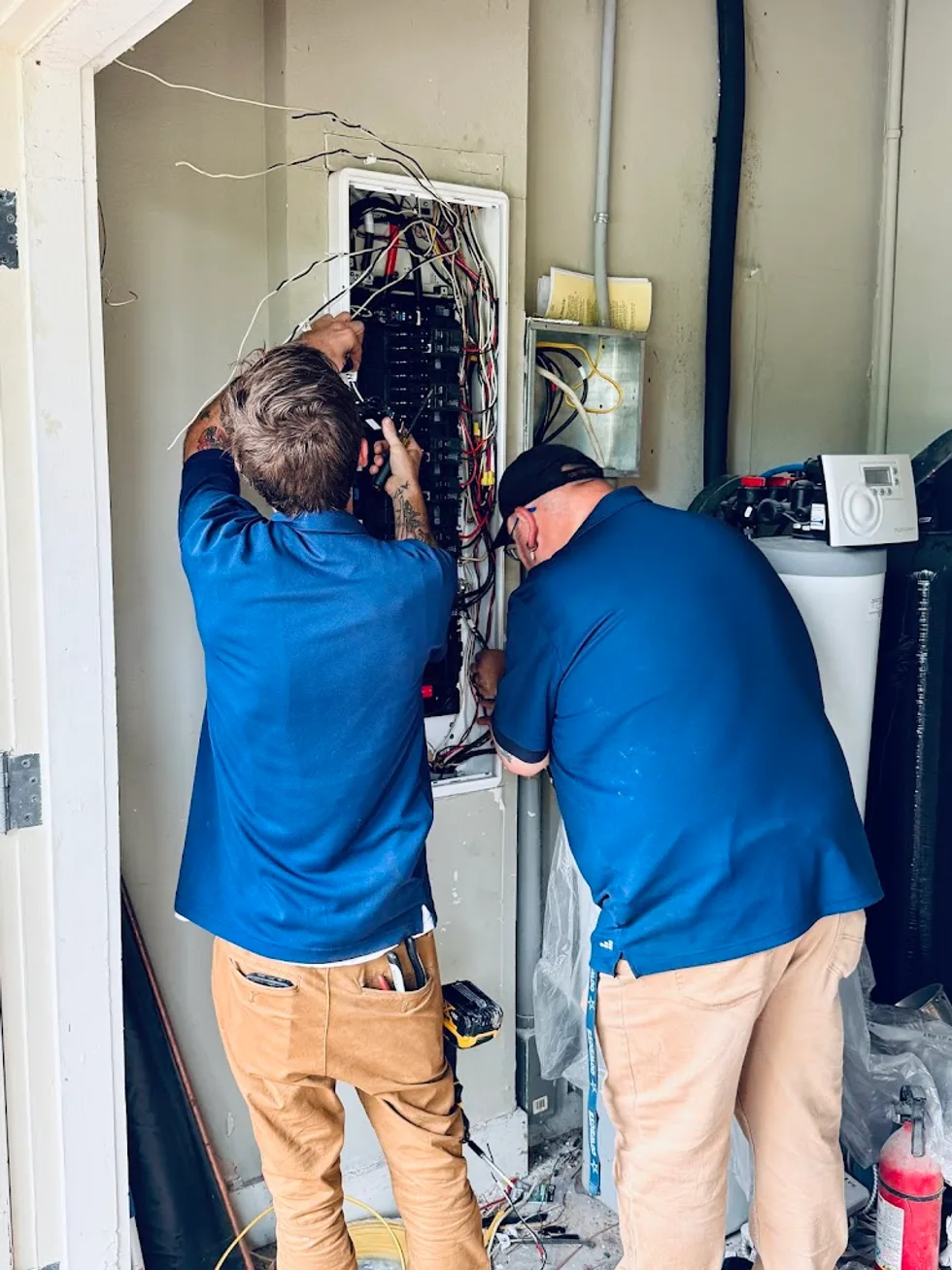
Homeowners put off rewiring for years because they picture dusty demolition crews ripping wide trenches across every wall. For occupied Austin homes, we treat wall preservation as half the craft:
- Crawlspace + Attic Vertical Fishing: In single-story pier-and-beam homes, we drill cleanly up into bottom plates from the crawlspace for receptacles and down through attic top plates for switches and ceiling boxes — pulling fresh copper vertically inside hollow stud bays.
- Flexible Fiberglass Fish Rods & Borescope Cameras: Before making any cut on a concrete-slab or two-story home, we inspect inside the stud bay with an illuminated borescope camera to route around horizontal fire-blocking and plumbing stacks.
- HEPA Dust-Shroud Cutters & Drop-Cloth Protection: Whenever a small surgical access port is unavoidable on a two-story slab ceiling, we cut clean, easily patchable geometry using vacuum-shrouded oscillating tools over canvas drop cloths.
- Room-by-Room Daily Power Restore: If you’re living at home during a 5-day whole-house rewire, we stage circuits sequentially so your AC, fridge, Wi-Fi, and bedrooms come back online before our trucks leave each afternoon.
Why rewiring and panel upgrades belong in the same conversation
Pulling brand-new grounded copper circuits back to an undersized, rusted 100-amp exterior box — or an FPE Stab-Lok / Zinsco panel — leaves the heart of the system bottlenecked. Bundling your rewire with an electrical panel replacement or 200-amp service upgrade saves duplicate permit and labor mobilization costs, adds dual 8-foot driven copper ground rods, includes UL 1449 whole-house surge protection and up to 6 interconnected 10-year smoke & CO detectors, and backs your new panel with our written 10-year workmanship warranty (plus 5-year workmanship warranty on all branch wiring).
Check Your Home’s Wiring Era & Wall-Preservation Path
Select the decade your Austin home was built and its foundation type to see typical hidden wiring inside the walls, insurer rules, and how our crew fishes copper with minimal wall patches.
How to plan an older-home rewire in Austin without gutting your walls
- Identify your home's build decade and foundation first. A 1935 Hyde Park pier-and-beam bungalow with crawlspace access beneath and attic access above fishes very differently than a 1968 Northwest Hills two-story on a concrete slab.
- Separate true fire hazards from low-draw circuits that only need AFCI/GFCI protection. Active knob-and-tube or heat-cracked cloth wiring must be retired, whereas healthy mid-century copper on low-draw bedroom lighting can often be protected safely at the panel while you rewire high-load kitchen, bath, office, and HVAC circuits in fresh grounded copper.
- Pair branch rewiring with a modern copper-bus panel and dual ground rods. New grounded copper Romex and whole-house surge protectors only work when landed on a healthy 200-amp Square D or Eaton busbar bonded to driven copper ground electrodes.
- Keep signed TECL #38552 permit and completion documentation for insurers and future buyers. Passed City of Austin electrical inspections plus a Master Electrician completion letter permanently protect your home's insurability and resale value.
- Brittle black or silver cloth insulation crumbling to bare copper inside ceiling fan boxes or attic junctions
- 3-prong receptacles installed on old 2-wire cables ('bootleg' or open grounds) that leave surge strips and computers unprotected
- 1965–1976 solid single-strand aluminum branch wiring showing warm cover plates, flickering lights, or scorched wirenuts
- A homeowners insurance underwriting notice (Chubb, USAA, State Farm, Travelers, or Texas FAIR Plan) requiring licensed TECL #38552 sign-off within 30 days
Common questions
How much does it cost to rewire a 1,500 to 2,200 sq ft older house in Austin?
Do you have to tear open all my plaster or drywall to rewire my house?
Do I always need a full whole-house rewire if my 1950s Austin home has 2-wire ungrounded outlets?
What is the best fix for 1965–1976 aluminum branch wiring in Austin?
How long does a whole-house rewire take while we live in the home?
How do I schedule a licensed Austin electrician for electrical troubleshooting or repair?
Ready when you are.
Book online anytime or call our Austin office — our licensed team is glad to help you get it taken care of cleanly and safely.