1965–1974 Austin Home Safety & Insurance Sign-Off · TECL #38552
CPSC-compliant aluminum wiring remediation without gutting your drywall.
Homes built across Austin between roughly 1965 and 1974 — including streets in Barton Hills, Northwest Hills, Allandale, Westlake, Oak Hill, University Hills, and early Round Rock — often used single-strand 12 AWG and 10 AWG aluminum branch wiring for 15A/20A outlets and lights. We perform CPSC-recognized AlumiConn copper-pigtail remediation and provide formal TECL #38552 documentation for Texas homeowners insurance carriers and home sales.
CPSC-recognized AlumiConn lugs No whole-home drywall tear-out Insurance compliance letter
Certified & Accredited
Don't take our word for it.
Best Pick for the 4th year — Best Pick Reports
Angi Service Award Winner — 2018–2025
5.0 on Google · 491 reviews
Tesla, Eaton & SPAN Certified Installers
Licensed, Bonded & Insured
Why 1960s–70s Aluminum Branch Circuits Overheat
Aluminum expands more than copper, oxidizes when exposed, and creeps loose under brass screws.
Important distinction first: modern multi-strand AA-8000 aluminum utility feeders and 200A service entrance cables are completely safe and code-standard today. The hazard flagged by the U.S. Consumer Product Safety Commission (CPSC) and Texas home insurers applies specifically to 1965–1974 solid single-strand 15A and 20A branch-circuit aluminum wire landing on standard copper-only outlets, switches, and twist-on wire nuts.
Each time a space heater, hair dryer, microwave, or vacuum draws load, solid aluminum expands roughly 30% more than brass terminal screws, then cools slightly looser ("cold creep"). As air enters the microscopic gap, aluminum oxide forms — which resists current and turns the outlet or light junction box into a hidden heating element.
What’s Included With DC Electric
- Early warning signs: warm faceplates, flickering room lights, intermittent dead outlets in a daisy chain, or faint hot-plastic odor
- Per CPSC Publication 516, "CO/ALR" device-only swaps are classified as an incomplete, temporary measure (and CO/ALR ratings do not exist for ceiling fixtures, GFCI outlets, or smart dimmers) — only full copper rewiring, COPALUM crimps, or torque-calibrated AlumiConn copper pigtailing are CPSC-recognized permanent repair methods
- Purple antioxidant twist-on wire nuts press aluminum and copper directly together and have documented field overheating failures
- AlumiConn multi-port mechanical lugs keep aluminum and copper conductors in separate tin-plated ports with silicone antioxidant gel and calibrated set-screw torque
Device-by-Device Remediation Without Rewiring Walls
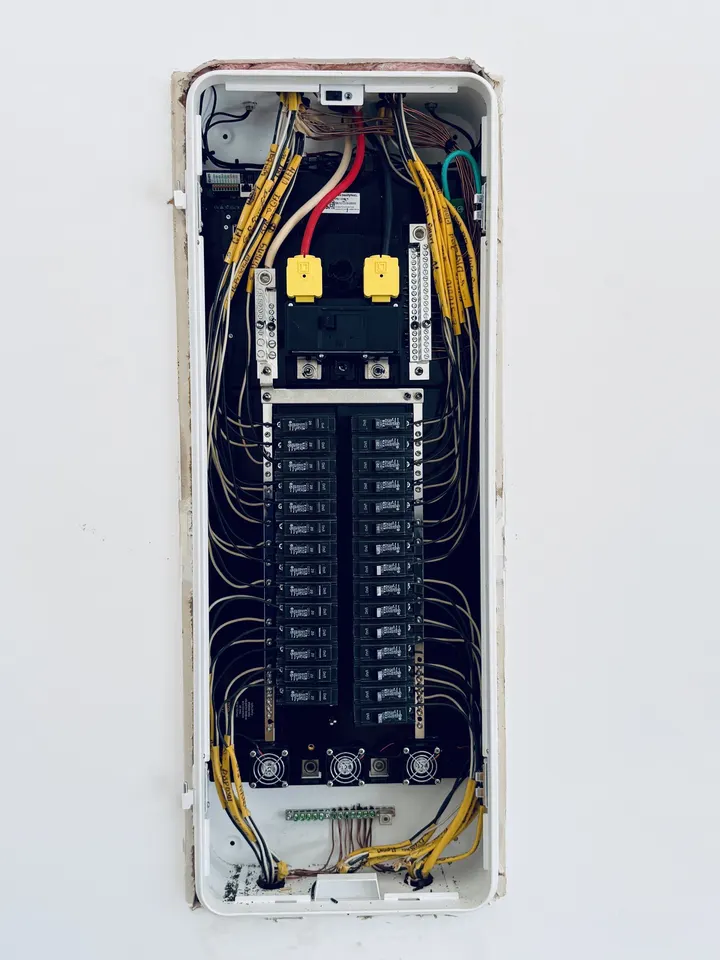
Every outlet, switch, light box, dishwasher splice, and panel termination inspected and pigtailed.
Tearing open finished plaster or drywall across an entire Barton Hills or Northwest Hills ranch house costs tens of thousands of dollars in carpentry and paint alone. CPSC-recognized copper pigtailing with UL-listed AlumiConn lugs solves the problem where 99% of aluminum failures actually happen: at the terminations.
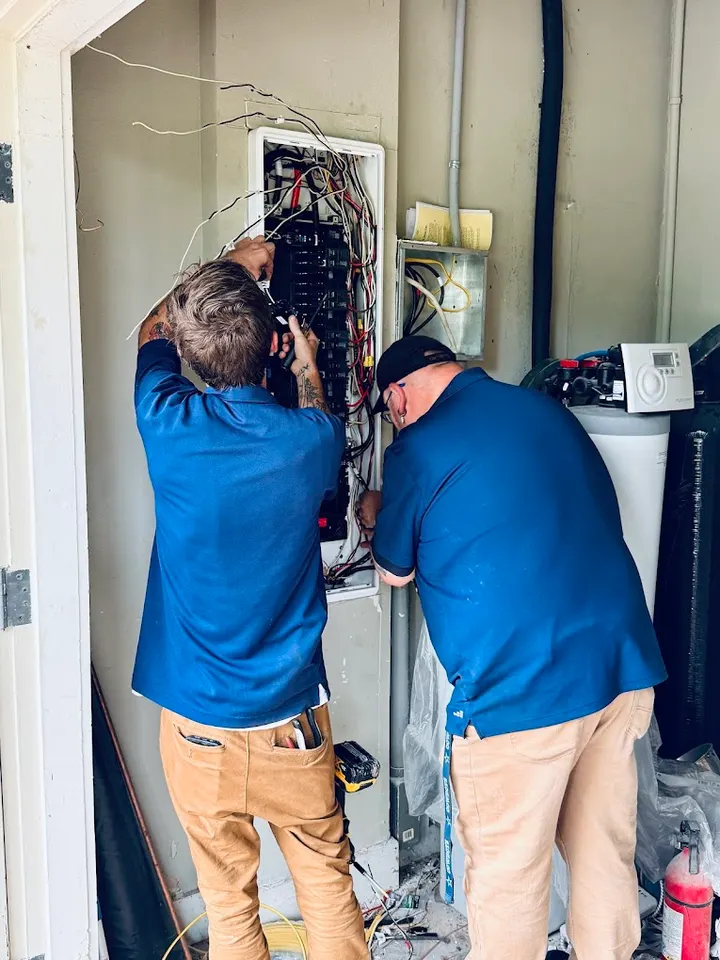
Our licensed electricians open every receptacle, switch, ceiling fixture, attic junction box, hardwired appliance splice, and panel bus termination on your aluminum branch circuits — trimming heat-stressed wire ends, torquing each conductor inside individual AlumiConn ports with a calibrated torque screwdriver, installing fresh commercial-grade copper devices, and verifying box fill.
What’s Included With DC Electric
- Pre-purchase home buyer/seller inspections to verify how many circuits in a 1965–1974 home are actually solid aluminum vs. copper
- Upgraded deep junction boxes or sleek box extenders where multi-gang 1960s steel boxes need code-compliant cubic-inch volume
- AFCI (arc-fault) and GFCI breaker protection paired at the panel for an added layer of modern arc-detection safety
- Formal signed TECL #38552 remediation certificate & scope breakdown accepted by major Texas homeowners insurance underwriters
Free Homeowner Safety Tool
60-Second Electrical Emergency & Utility Outage Triage
Select what your home is doing right now. Get plain-English safety steps — including an honest check on whether your local electric utility fixes the problem at $0 utility cost before you hire an electrician.
Immediate Fire Hazard · Act Now
Turn off that circuit breaker immediately — do not plug anything back in.
Electrical outlets, switches, and breaker housings are molded from heat-resistant thermoset plastics. When a loose wire lug, backstabbed receptacle, or failing breaker begins arcing, those polymers release a distinct acrid plastic or "dead fish" odor before visible smoke appears.
What to do in the next 60 seconds:
- If you see active smoke or flame, evacuate everyone (and pets) immediately and call 911 from outside.
- If there is no smoke, go to your breaker panel and switch OFF the breaker controlling that room or appliance. If the main panel itself smells hot or buzzes loudly, shut off the Main Breaker only if the panel cover is cool to the back of your hand.
- Never touch a scorched metal outlet screw or wet floor, and do not flip an overheating breaker back ON "just to test it."
Who handles this: DC Electric Licensed Troubleshooter (Customer-Side Wiring/Panel)
Utility crews cannot repair interior outlets or branch breakers. A licensed electrician should open the box, cut back heat-damaged copper insulation, and torque a commercial-grade replacement.
Read full Burning/Fishy Smell Safety Guide →Check Free Utility Service Leg First
One of your two 120V power legs is out — check your utility before paying an electrician.
Every Austin home receives two 120V hot legs (240V total) from the utility transformer. When one leg drops, roughly half of your 120V lights/outlets go dark and 240V appliances (central AC, electric dryer, oven, EV charger) stop running—even though no breaker looks tripped.
What to do in the next 60 seconds:
- Turn OFF your central AC thermostat and unplug sensitive 240V equipment so a partial-voltage leg does not damage compressor windings.
- Call your electric utility outage line below FIRST and report "partial power / dropped leg." Over half the time in Central Texas storms or heatwaves, the loose lug is on the utility pole or pad transformer — and your utility repairs their side at $0 cost to you.
- If your utility tests the meter and confirms full 240V arriving at the meter base, the failure is customer-side (corroded meter jaws or a failed main breaker) — call DC Electric and we will take it from there.
Who handles this: Call Your Utility Outage Line First ($0 Utility Check) → Then DC Electric
We never want an Austin neighbor paying a service fee for a utility-owned pole splice. Always let Austin Energy, Oncor, PEC, Bluebonnet, or GUS verify their drop first.
Explore Customer-Side Main Breaker & Meter Repairs →High Priority · Loose Neutral Risk
Brightening lights signal a dangerous loose neutral — protect electronics today.
A brief 1-second dip when a 4-ton AC compressor starts can be normal inrush current (often cured with an AC soft-start). However, if lights in one room get noticeably BRIGHTER while lights elsewhere dim when a microwave, toaster, or hair dryer runs, your 120V legs are unbalanced due to a failing neutral connection.
What to do in the next 60 seconds:
- Unplug expensive electronics, OLED TVs, and countertop appliances on affected circuits — a floating neutral can send 145V–170V into a 120V outlet and fry control boards.
- If overhead tree limbs rub your backyard power drop (common in Tarrytown, Hyde Park, Barton Hills & Travis Heights), ask your utility to check their overhead neutral splice while scheduling an inspection of your main panel neutral bus.
- If flickering happens ONLY on one dimmer switch with LED bulbs, it is safe — usually an incompatible legacy dimmer rather than a loose neutral.
Who handles this: DC Electric Diagnostic Evaluation (+ Utility Check if Overhead Drop)
We test voltage under load at both the meter and main panel busbar so we pinpoint whether the loose neutral is inside your panel or out at the utility tap.
Read Austin Flickering Lights Diagnostic Guide →Latent Fire Hazard · Plan Replacement
High-failure breakers and oxidized aluminum splices look normal until overloaded.
Homes built across Austin between 1950 and 1982 frequently still carry Federal Pacific Electric (FPE Stab-Lok) or Zinsco / Sylvania panels—documented for failing to trip during overloads—or 1965–1976 single-strand aluminum branch wiring that expands and loosens at brass outlet screws.
What to do in the next 60 seconds:
- Do not pry off the dead-front metal inner cover yourself, and avoid running space heaters or high-draw EV adapters on legacy FPE/Zinsco circuits.
- Look at the inside door label: red-tipped breakers or "Stab-Lok" indicate Federal Pacific; pastel blue/pink/green vertical handles indicate Zinsco.
- Schedule a pressure-free evaluation. We replace high-failure hazard panels in one coordinated day (backed by our 10-year panel warranty) and perform CPSC-recognized AlumiConn torque-verified remediation.
Who handles this: DC Electric Panel & Remediation Team (TECL #38552)
Replacing an FPE or Zinsco panel also resolves the #1 red flag on Texas homeowners insurance renewals and TREC real estate option-period inspections.
See Same-Day FPE & Zinsco Replacement Details →Shock Protection Active · Do Not Force
Your GFCI or AFCI is doing its job — trace moisture or hidden upstream resets.
After heavy Central Texas storms, wind-driven rain enters aging exterior bubble covers, holiday lighting cords, or pool/patio boxes. A single garage or bathroom GFCI receptacle often protects 4–8 downstream outlets across the house.
What to do in the next 60 seconds:
- Unplug every cord from outdoor patio, soffit, garage, and landscape outlets first.
- Check garage walls, bathrooms, laundry rooms, and exterior walls for a tripped TEST/RESET receptacle. Press RESET firmly with dry hands only after unplugging wet outdoor cords.
- If water is dripping INTO your main breaker panel or meter can, stand clear of wet concrete and call immediately — water inside a live busbar corrodes breaker jaws and can arc.
Who handles this: DC Electric Same-Week Repair (Weather-Resistant GFCI & In-Use Covers)
We upgrade leaky flat exterior flaps to NEC-compliant weather-resistant (WR) GFCI receptacles with heavy-duty weatherproof in-use covers.
Explore Weatherproof GFCI & Outlet Repairs →Check Beep Pattern First (4 Beeps = CO)
Count the beeps: 4 rapid beeps means Carbon Monoxide; 1 chirp means battery/age.
Hardwired 120V smoke and carbon monoxide alarms communicate interconnected alerts across every bedroom and hallway. Knowing the beep pattern tells you in seconds whether you have a life-safety emergency or an expired 10-year sensor.
What to do in the next 60 seconds:
- 4 rapid beeps, pause, 4 rapid beeps: Active Carbon Monoxide (CO) alarm. Move everyone outside to fresh air immediately and call 911 — CO is odorless and invisible.
- 3 loud beeps, pause, 3 loud beeps: Smoke/fire alarm trigger (or heavy steam/attic dust inside an aging sensing chamber). Verify no fire or hot electrical smell first.
- 1 single chirp every 30–60 seconds: Low backup battery OR end-of-life timer. NFPA 72 requires replacing every smoke/CO unit every 10 years because sensors lose sensitivity.
Who handles this: 911 if 4-Beep CO / Smoke Emergency · DC Electric for 10-Yr Hardwired Replacement
We replace aging chirping alarms house-wide in one visit with interconnected 120V photoelectric smoke + CO units carrying sealed 10-year lithium backups.
See Whole-Home 10-Year Smoke & CO Replacement →Verified Dispatch Log · Greater Austin
Recent residential work completed near Greater Austin
Anonymized completed job records synced from our ServiceTitan dispatch log (429+ Greater Austin residential projects completed over the last 6 months). Customer names and street addresses are omitted for homeowner privacy.
429+ Metro JobsVerified · TECL #38552
200-Amp Panel & Austin Energy Meter Base Upgrade
Dedicated Circuit, GFCI/AFCI Protection & Smart Switch Install
Dedicated 240V Hot Tub, Spa / Sauna & GFCI Disconnect Wiring
Need similar electrical work in Greater Austin? Book online 24/7 for an exact written price before work begins.
Schedule My Evaluation →
Common Questions
Answers about aluminum wiring remediation in Austin
My home inspector saw aluminum wire inside my breaker panel — does that mean my whole house has aluminum wiring?
Not necessarily! Many 1970s–2020s Austin homes have completely safe copper 15A/20A room circuits alongside heavy multi-strand aluminum cables solely for the 200A utility main, 50A range, or AC subpanel — which is normal and code-compliant. We inspect both the panel and sample room outlets/switches so you never pay for remediation you do not actually need.
Will Texas homeowners insurance companies accept AlumiConn pigtail remediation instead of a full house rewire?
In nearly all cases, yes. Most Texas underwriters refusing raw 1960s/70s solid aluminum branch wiring specifically require CPSC-recognized copper pigtailing (COPALUM or King Innovation AlumiConn lugs — not standard wire nuts) performed and certified in writing by a licensed Texas Electrical Contractor (TECL #38552). Always share your carrier’s exact wording with us and we align our certificate directly to their checklist.
How long does whole-home aluminum wiring remediation take?
Depending on home square footage and total device/fixture count (typically 45 to 95 openings), most single-family Austin homes are completed in 1 to 3 days with room power restored each afternoon and zero drywall demolition.
Can you replace our Federal Pacific or Zinsco panel at the same time as aluminum wiring remediation?
Yes — 1965–1974 Austin homes frequently have both solid aluminum branch circuits and an original Federal Pacific Stab-Lok or Zinsco panel. Combining a 200A copper-bus panel upgrade with AlumiConn branch remediation resolves every electrical underwriting flag on the home in one coordinated project.
Explore Related Services & Guides
Connected electrical work across Greater Austin
In Our Neighbors’ Words · Greater Austin
We treat every home like our own. Here’s what neighbors say about DC Electric.
Being invited into your home is a privilege we never take for granted. Every story below comes straight from a Greater Austin homeowner we’ve served — with the work we did and the DC Electric crew who showed up.
5.0 ★ · 491 Verified Google Reviews
⚡ 200A Panel Replacement & Austin Energy Permit · Austin, TX
“The DC Electric team was phenomenal! They came out and replaced a tricky inset panel in one day. Rodney, Anthony, Andrew, Rico were professional, quick, and filled us with confidence that they could get the job done. They worked with Austin Energy to get permits approved and finish the inspection in record time. We are beyond impressed with their excellent work! This was no easy job.”
H✓
Helen Siegel
J✓
Juan Villa
“Nick came out for the quote — kind and thorough, and helped me think through all the work. Install day was flawless: the crew put in a car charger, 16 can lights, and two new circuits, and insisted on making it perfect. They are not the cheapest electricians in town, but you absolutely get what you pay for.”
Crew: Nick & Install Crew
Google review ↗
M✓
Margaret McKinney
“I purchased a 1951 home with multiple electrical issues on the inspection. Every deficiency was addressed — and they told me which components did not need updating. A storm rolled in while I was away and the techs closed all my windows. I came home to a dry house.”
Crew: Master Diagnostic Crew
Google review ↗
J✓
Joe Sims
“I needed to replace my panel, and add outlets to the bathroom and garage. Pete was helpful in getting my estimate. Max and Rico did a great job with the installation. Everyone was very friendly. The pricing was straightforward and fair. They had me scheduled fairly quickly and finished the job quickly.”
Crew: Pete, Max & Rico
Google review ↗
L✓
Linda Ball
“They showed up right on time and worked nonstop in the heat, provided a generator so we had power while they worked, answered every question, explained everything, and cleaned up before leaving. I’ll definitely use them again.”
Crew: Master Service Upgrade Crew
Google review ↗
P✓
Patrick Caldwell
“Big thank you to Rodney, Max and Pete from DC Electric who helped us install new recessed lights in our kitchen. They were on time, super helpful working out what would work best, did a good quality install and clean up and were very friendly and easy to work with. Will definitely use again!”
Crew: Rodney, Max & Pete
Google review ↗
C✓
Claire Moore
“We got multiple bids to restore power to our garage unit, and the team at DC were the easy choice. Scheduling was easy, communication was consistent, and most importantly, they took care of everything thoroughly — complete on time, with no surprises.”
Crew: Diagnostic & Repair Crew
Google review ↗
C✓
Christopher Brookover
“Fast, efficient, clean, and extremely knowledgeable about the hardware and setup. Ed and the crew walked me through the whole system and I’ve spent hours playing with my new SPAN setup!”
Crew: Ed & SPAN Certified Crew
Google review ↗
C✓
Carly Hustvedt
“Andrew and Jonathan did an amazing job installing our EV charger. They walked us through the setup, stayed true to the quote, and left the garage cleaner than they found it.”
Crew: Andrew & Jonathan
Google review ↗
A✓
Acer Pahukoa
“Rico, Rodney and Nathan were professionals with my charger install. Explained every step of the process to me, informed me of every step during the install, and walked me through final install and operation. Left a clean work space, and their final work looked very clean. Highly recommend!”
Crew: Rico, Rodney & Nathan
Google review ↗
1 / 3
Aluminum Wiring Remediation in Austin, priced clearly before work begins.
Book online 24/7 or call 512.954.4782. A licensed DC Electric electrician evaluates your home in person, walks through options in plain English, and gives you one exact flat-rate written price.